|
EL37Sensibly equivalent¶ to:See also:
|
|
|
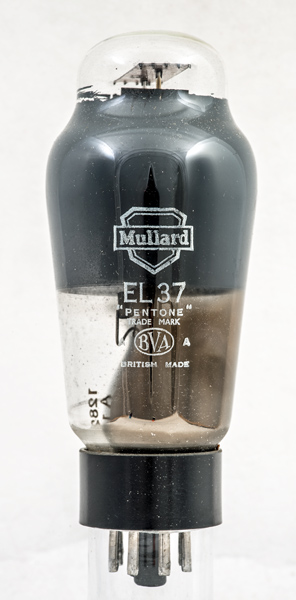
|
The EL37 audio output valve is one of the classic valves and its predecessor was the EL35.At a time of generally low power audio amplification, these valves used in push pull could deliver up to 69 Watts at 2.5% distortion. The EL37 and EL31 are both 25 Watt anode dissipation output valves from the mid 1940s. The main difference is that the EL31 has the anode brought to a top cap as the maximum anode voltage is 800 Volts and it is the extra anode voltage that gives the higher output power. Mullard also described the EL37 as suitable for use as drivers for large triode push-pull output stages. The EL37 has a high value of mutual conductance compared with the valves it is sensibly equivalent to. At 11.0 mA/V it is almost twice the value of the KT66 and the 6L6. A Mullard engineer said of the EL37 'that unlike similar valves it only needed a whiff of signal to drive it to full output. A single triode was all that was required to drive it'.Mullard gave example operating conditions that produced 20 Watts with a 250 Volt HT rail, and 35 Watts with a 325 Volt HT rail. The anode to anode transformer impedance would have been 4,000 Ohms in both cases. The anode dissipation was 25 Watts. This valve was designed for operation as a pentode but it was popular to operate audio valves as triodes for lower distortion. The ultra linear or distributed loading concept was not developed when these valves were used for new designs.This valve was rendered obsolete in 1954 with the introduction of the EL34 that also has a gm of 11.0 mA/V.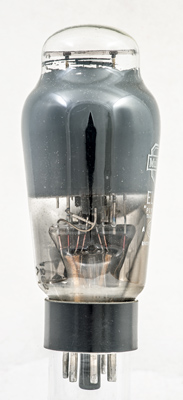
The lower components seen here are more closely seen in the article 'A Classic Unmasked'.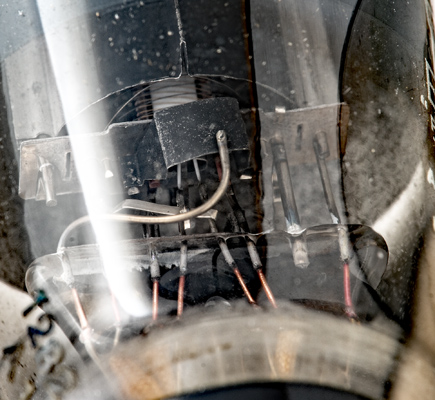
The three wire grids and coated cathode. The electrodes would have been assembled as a unit within a jig or jigs and you can see the bonds to the shaped leads from the pinch.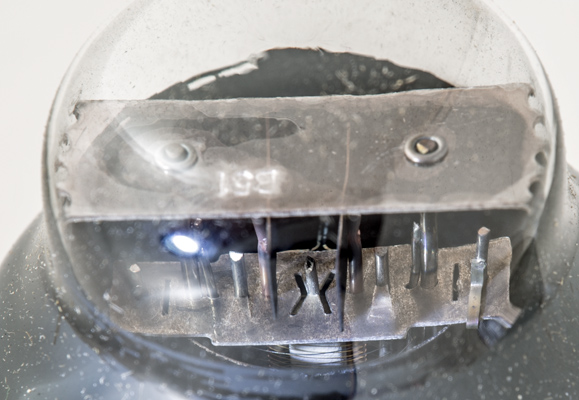
There are two top micas, the upper has fingers gripping the shoulder of the envelope and the lower fixes the tops of the elements in place. Note that the cathode tube is reduced in size to a small tube to pass through the mica.The classic envelope is 51 mm in diameter and, excluding the IO base pins, is 117 mm tall.References: Data-sheet, 1040 & 1043. Type EL37 was first introduced in 1946. See also 1946 adverts. |
Pin Connections
| 1 | 2 | 3 | 4 | 5 | 6 | 7 | 8 |  m | h | a | g2 | g1 | nc | h | k,g3 |
|
|
Absolute Maximum Operating Conditions
| Vh | Ah | Va | Vs | Vg | mAa | mAs | ra | gm | Pout | D | 
| 6.3 | 1.4 | 250 | 250 | -13.5 | 100 | 13.5 | 13,500 | 11 | 10.5 | 10% |
|
Updated March 09, 2022.
|
|