home
 
timeline

AC/HL

new
 
showcase
{museum features}
Mazda
equivalents
354V - 41MHL - AR17 - CV399 - CV1037 - D4 - HL4 - MH4 - NR31 - VR37 - A30D - MHL4
articles
Shortpath Construction
collections
The John Lawrence Collection
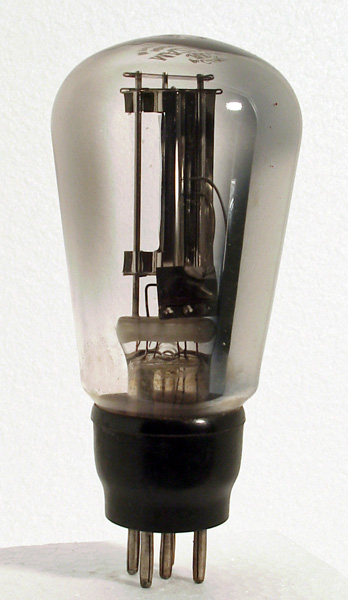
The AC/HL indirectly heated amplifier triode makes use of the 'Shortpath' technique construction. The cathode assembly passes through the far end of an oval grid. The grid is fixed only at the outer end to a stout single rod. The anode is a thin sheet and is open at the front of the grid support. The channel formed by the anode sheet encloses the cathode and the far end of the grid.
This valve type, manufactured in the early 1930s and sold under the Mazda label, is the direct successor of the Landmark Cosmos AC/G of 1927/28.
The AC/G (high μ) and its companion the AC/R (lower μ) were the first technically successful indirectly-heated valves to achieve production status anywhere in the world, although many British and US firms had previously introduced less-than-satisfactory indirectly-heated types in small quantities. The heater rating (4 V @ 1 A) and the alumina-based heater/cathode insulation (initially in the form of clay slip) immediately became industry standards.
The AC/HL was a very long-lived valve. Many originals survive in working order and during the late 1960s it was claimed that a specimen removed from obsolete BBC studio equipment still met the original specification for a new valve after over 250,000 hours in service! Note that the Type No. AC/HL was also used by other brands of valve, including Lissen.
The oblique stroke is sometimes omitted in listings (ACHL instead of AC/HL).
The balloon envelope is 57 mm in diameter and, excluding the B5 base pins, is 110 mm tall.
 
Pin Connections
B5
1
2
3
4
5
a
g
h
h
k
 
Absolute Maximum Operating Conditions
Triode
Vh
Ah
Va
Vg
mAa
ra
gm
4.0
1.0
200
-2.75
6
10,000
3.5

Thanks to Frank Philipse for supplying the above datasheet
More

This exhibit was last updated on 03 June 2007
{find valves by name}