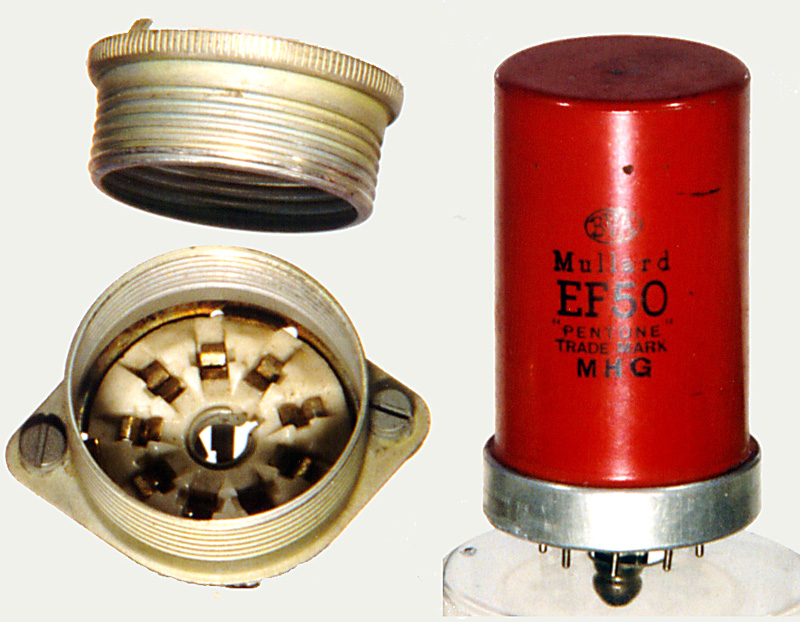
The EF50 was the ubiquitous red valve for a decade. Designed in 1938 by Philips of Eindhoven for Band I television receiver use and first released in 1939, this amplifier pentode was a general workhorse. It was extensively used in radio and radar during WWII. One additional reason that so many existed was that they had a short life and so were changed often.I first encountered this delightful valve in an old television receiver. The chassis had a row of five or six of them on either side of the picture tube. From RF through video to audio they were of service.They are an early all glass design as can be seen from the short pins and the metal base with centre spigot. The pins are equi-spaced around the circumference of the pin circle. Unlike the American metal valves, these have a glass envelope with a thin aluminium outer screening can.During mobile or airborne service, vibration would cause unseating of the valves. The picture shows the screw holder designed by the RAF. This held the valve firmly in place without making servicing difficult. Spring clips also became available for the bases, but the screw skirt is an excellent solution to the vibration problem.Our exhibit is unused. The skirt is wider than the body of the valve and the metal base has holes for the glass pips that surround the short pins. The central locating spigot is hollow and conceals the evacuation seal.The wide glass tube envelope is 32 mm in diameter and, excluding the B9G base pins, is 60 mm tall.References: Data-sheet & 1040. Type EF50 was first introduced in 1939. See also 1939 adverts. |