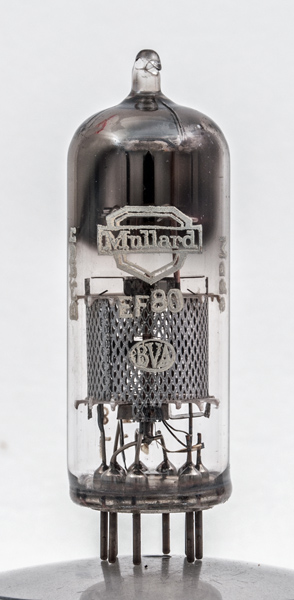
The EF80 internally screened pentode was a workhorse of the VHF TV receiver and was introduced in mid 1950 to replace the EF91. It was described by Mullard as: a high slope RF pentode and not a variable μ type. The EF85 was the variable μ counterpart to the EF80.The EF80 was much used for RF, intermediate frequency, and video amplification.The 'bog standard' TV of the later 1950s was full of EF80s (or equivalents). In those days all British TVs were monochrome, 405-line standard, with a typical video IF of 33 MHz. The EF80 worked well at 40 MHz and also gave adequate performance at up to 100 MHz. The EF80 was superseded in the 1960s by the higher slope frame grid EF184 the EF183 being the variable μ design.The EF80 was a reliable design.The circuit designer is given maximum flexibility by having all electrodes brought to external pins. Many pentodes have g3, the suppressor grid, internally connected to the cathode.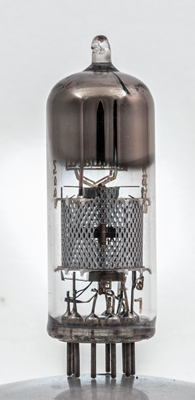
Through the hole in the screen can be seen the strap at the rear that connects the two halves of the anode. In front the open helix of the suppressor grid is visible. Deeper in the screen grid can be seen to pass flat across the cathode. Just visible is the fine pitch of the control grid that also passes flat across the cathode.The thin glass tube envelope is 20 mm diameter and excluding the B9A base pins, is 58 mm tall.References: Data-sheet & 1040. Type EF80 was first introduced in 1950. See also 1950 adverts. |