|
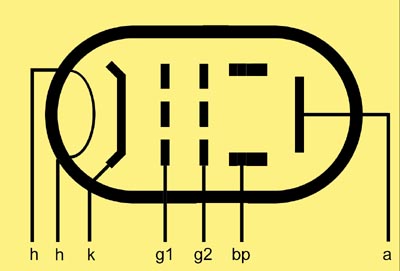
The beam tetrode was developed as manufacturers were looking for a way to make audio output valves that would not infringe the Mullard (Philips) patent for the pentode. In the UK two EMI engineers developed and patented in 1933 the Beam Tetrode. MOV owned half of EMI but considered the design too difficult to make. MOV also had an exchange agreement with RCA of the USA and the development passed to America.
A beam tetrode employs principles not found in other types of valves in that the electron stream from the cathode is focused towards the anode. The control grid and the screen grid are made with the same winding pitch and they are assembled in the valve so that the turns in each grid are in optical alignment.
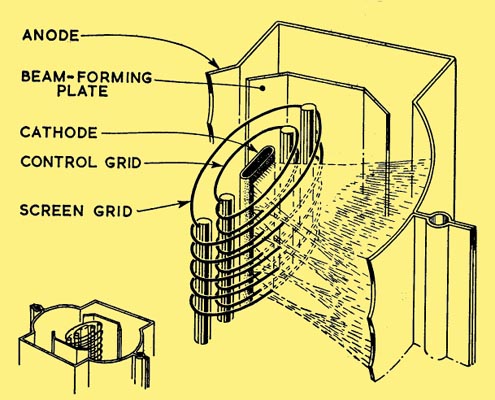
The effect of the grid and screen turns being in line is to reduce the screen current compared with a non-beam construction. For example, in a pentode of ordinary construction the screen current is about 20 per cent of the anode current, whereas in a beam valve the figure is 5-10 per cent. The other feature was two shaped metal plates that ran the length of the grids and was placed outside the grid support rods but within the anode cylinder. The effect of these plates was to confine the electron flow to the path through the grid wires by forming an electrostatic field when connected to a low voltage. This had the effect of repelling secondary electrons back to the anode and by not having the secondary electrons reach the screen grid, the kink in the Tetrode curve was eliminated. The Kinkless Tetrode was born.
RCA did have facilities to successfully translate the design into a working valve. The result was the 6L6. It was more efficient than an equivalent Pentode, due to lower screen dissipation, happily it also produced one third less third harmonic distortion. The ear is reasonably tolerant of second harmonic distortion up to about 5% but not third harmonic distortion which must be reduced to very low levels for good quality sound. The Triode produces inherently lower third harmonic distortion than other valve types. The Pentode produces significant amounts.
Within a few years most manufacturers had introduced Beam Tetrodes for audio output service. Mullard remained loyal to the Pentode. The top honours went to MOV for their KT range, especially the KT66 and later the KT88.
Beam tetrode valves were originally developed for use as audio-frequency output valves, but the principle was also applied to many types of radio-frequency tetrodes both for receiving and transmitting. Their superiority over pentodes for AF output is due to the fact that the distortion is caused mainly by the second harmonic and only very slightly by the third harmonic, which is the converse of the result obtained with a pentode. Two such valves used in push-pull give a relatively large output with small harmonic distortion because the second harmonic tends to cancel out with push-pull connection.
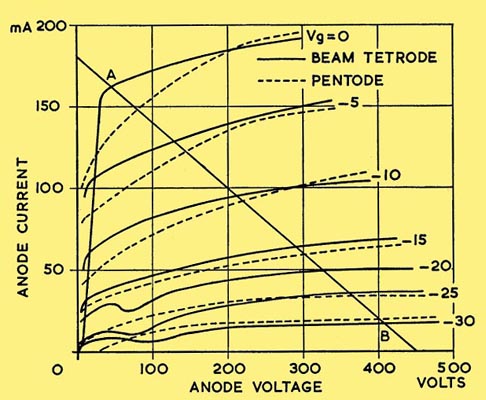
The characteristic curves of a beam valve and a pentode of equivalent size. The line AB is a load line drawn on the curve. It will be seen that the line extends farther to the left before it cuts the zero grid-volts curve than is the case with the pentode; this indicates a greater power output because the power output is proportional to the product of the change in anode voltage between points A and B on the horizontal axis and the change of anode current between points A and B on the vertical axis.
By the 1960's the term Power Tetrode was in use and the term Beam Tetrode dropped. All tetrodes were constructed to the beam tetrode model and with circular cathodes and grids the beam plates were no longer required and so removed from connection diagrams.
|