|
LS5Sensibly equivalent¶ to:See also:
|
|
|
|
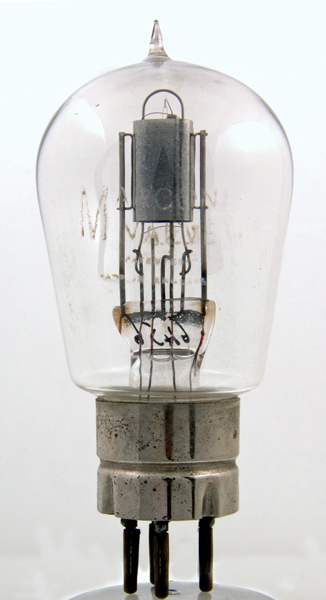
The LS5 from M-OV is a triode designed, in 1923, especially for driving a loudspeaker and featured many developments in valve design. The LS5 had, for its day, a high anode dissipation of 10 Watts. The characteristics PDF is from 1926.It was of the early dull emitter valves to be introduced by M-OV who were the first manufacturer to introduce thoriated tungsten filaments. This introduction followed intensive research from 1919 onwards. The use of the V shaped filament with tension spring was new as was the flattening of the anode cylinder and grid helix. 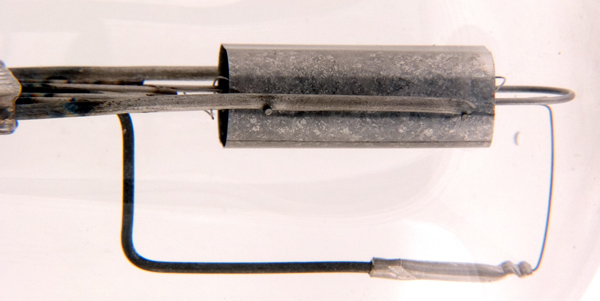
Seen in side elevation is the anode. This is a bright sheet of nickel bent to shape. The lower structure is the filament tension spring support arm. The thoriated tungsten filament was carbonized to offer an increased measure of protection from any residual gas in the envelope. The valve itself is not gettered. 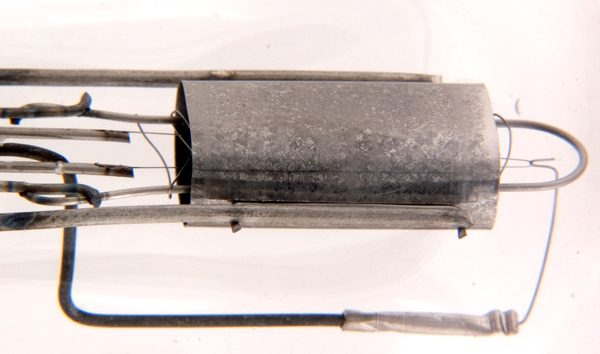
Seen from a slightly different angle, the complexity of the fixing structures become clear. In particular the anode is not directly attached to the main supports but is welded to an intermediate wire support on each side. The filament can be seen as a very fine wire.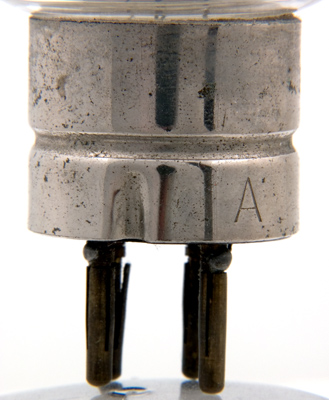
The base uses a metal shell base with a central groove to support the inner bakelite. The pins are of two part construction.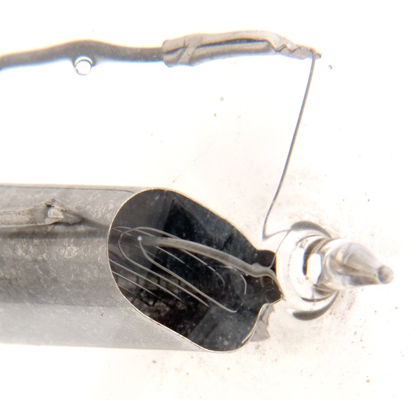
The grid can be seen to be a flattened spiral but is of open pitch and not wound under tension around the supports. The grid seems to be welded at the contact points with the supports and not, as in later construction, held in notched formed in the supports at winding time.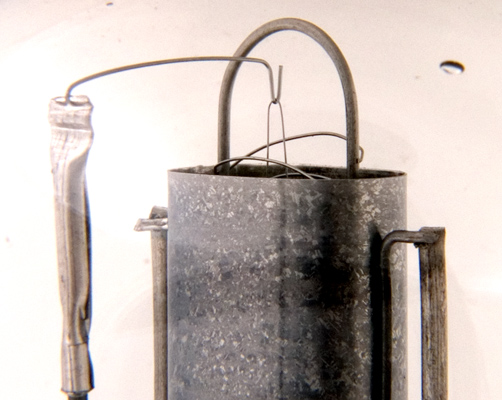
The tension spring and support is formed in three parts: stout support, sleeve and spring itself. The filament rests in a v formed at the end of the spring. This tension prevented the filament from sagging when hot. The grid can be seen to be formed on a wire formed into a top loop. Possibly this arrangement also puts the grid wire under tension to keep it in shape when hot. The anode connection is clearer in this image and reveals that the support wires are spaced from the anode by the intermediate supports.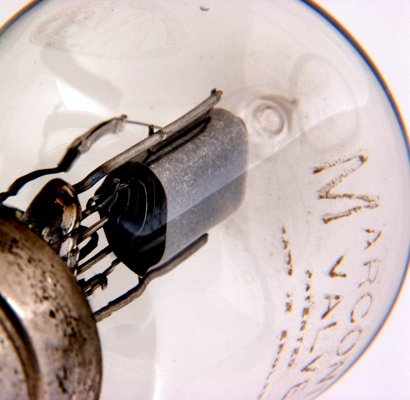
The electrodes seen up from the base. Note that the identification is etched into the glass envelope.See also POVT25 a UK Post Office valve that is an LS5 on a custom base.The balloon envelope is 52 mm in diameter and, excluding the B4 base pins, is 118 mm tall.References: 4051 & 1004 Type LS5 was first introduced in 1923. See also 1923 adverts. |
Pin Connections
| 1 | 2 | 3 | 4 |  a | g1 | f | f |
|
|
Absolute Maximum Operating Conditions
| Vh | Ah | Va | Vg | mAa | ra | gm | μ | 
| 4.5 | 0.8 | 400 | -20 | - | 6,000 | 0.83 | 5 |
|
PDF scanned from an original document held by the museum |
Updated October 05, 2018.
|
|