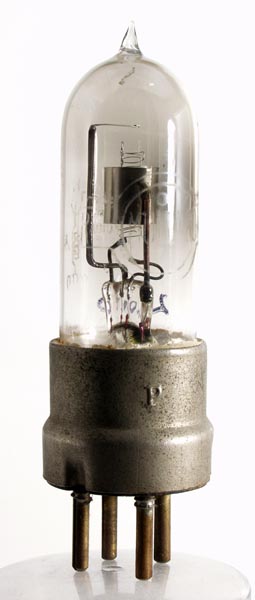
The ORA from Mullard was designed in 1922 as a development of the K valve and the redesign was prompted by the commencement of broadcasting. This exhibit is one of the early samples as later production had a balloon envelope.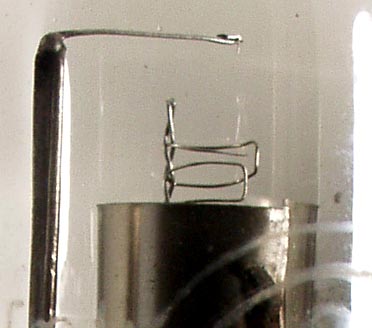
The grid wire is held in a pair of wires twisted together.The ORA stands for Oscillator, Rectifier, and Amplifier - its planed usages. It is a bright emitter valve and had a μ (amplification factor) of 8.5.In construction, the valve has a metal skirt and the familiar tubular anode. The grid is a curved folded arrangement as seen above and the filament is a single strand, tensioned by the support arm. See ORA for a version with a wire helix grid fixed to a rigid support.The thin glass tube envelope is 24 mm in diameter, and excluding the B4 base pins, is 83 mm tall.Reference: 1003. Type ORA was first introduced in 1922. See also 1922 adverts. |