|
VMS4BSensibly equivalent¶ to:See also:
|
|
|
|
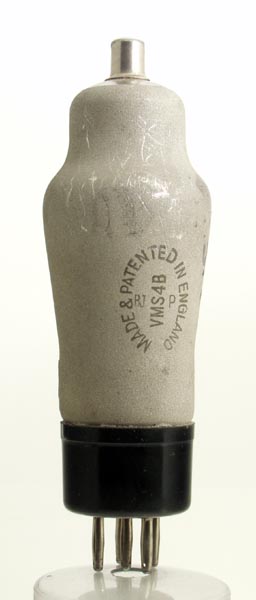
The type VMS4B typifies the swansong of the screen-grid receiving valve with anode top cap. It is an improved, vari-mu RF/IF tetrode intended for domestic superhet receivers but it represents the final milestone on the road which started (barely 10 years earlier) with the Type S625. Like the first screen valves the envelope above the base is a straight tube for a distance to facilitate through chassis mounting. VMS4B is a later example without this straight tube section.Unlike VMS4B this valve is encased in an external metallising paint. This would assist the screening of the electrodes from external fields but also would have hidden the insides from the customer. This was common practice with the Azide process.After the generation of valves that includes the VMS4B the screen-grid type was superseded by kinkless tetrode or pentode types based on American prototypes and with grid top caps.The main advantage of the pentode or kinkless tetrode in comparison with the simpler screen-grid type was the much larger undistorted output signal handling capacity, not limited by the characteristic screen-grid kink.This meant that kinkless valves could easily handle IF signal levels of 40 V or more without objectionable intermodulation distortion. An IF signal level of 40 V may sound excessive but it can be needed if, say, -40 V of AGC bias has to be generated in the detector stage in order to suppress an over-loud local transmitter.The number of equivalents suggests that this was a popular valve in its day.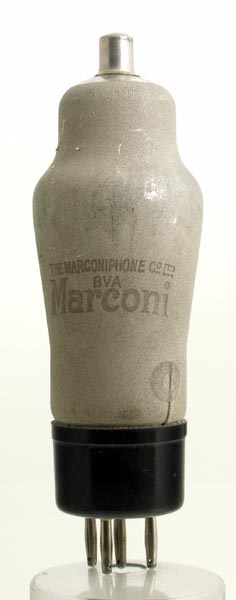
Opposite the valve type designation is printed the brand name. Also visible is the wire emerging from base that connects to the metallising that would be earthed in use.The classic envelope is 44 mm in diameter and, excluding the B5 base pins, is 122 mm tall.References: Data-sheet & 1005 Type VMS4B was first introduced in 1933. See also 1933 adverts. |
Pin Connections
| 1 | 2 | 3 | 4 | 5 | tc |  g2 | g1 | h | h | k | a |
|
|
Absolute Maximum Operating Conditions
| Vh | Ah | Va | Vs | Vg | mAa | mAs | gm | 
| 4.0 | 1.0 | 200 | 80 | 0 | 8.0 | 1.5 | 2.9 |
|
Updated November 13, 2021.
|
|