|
DET23Sensibly equivalent¶ to:See also:
|
|
|
|
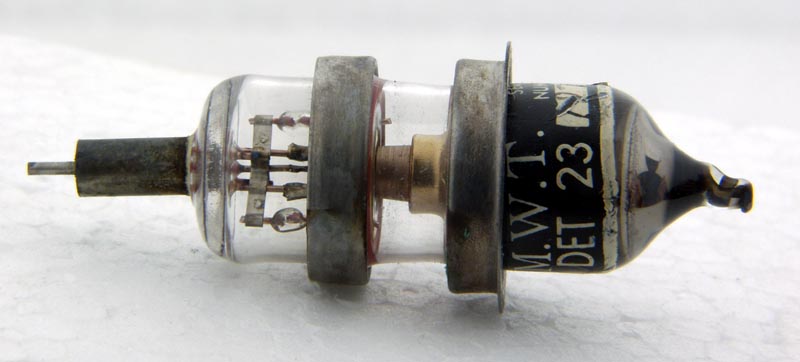
The DET23 was used in airborne radio. The UK services purchased to a specification from both M-OV and Mullard. The M-OV valves had a black label and the Mullard a white label. Both should have given the same performance, but in practice the M-OV valves had a slight edge. Over time the specification from the RAF altered to favour the M-OV DET23, which then took the greater part of the business.Technically the difference in the two makes was a slightly thicker wire gauge used in the M-OV for the flying leads. These were made of red platinum at 0.6 mm diameter. The thicker wire increased the problems of achieving a good durable vacuum seal, but avoided the operational dip in performance over a narrow band of frequency. The latter effect being known as 'suck-out'. The DET23 was in production from the post war period up until the mid 1950s.This physically small disc seal valve has, of course, co-axial connections. The heater and cathode are opposite the main envelope. The grid has a circular connection to the flat internal metal mesh. The anode appears to be copper and has a flat surface facing the grid. For an example of the construction technique see CV90A grounded grid configuration would allow for a two cavity mechanical design.The disc seal (glass) envelope is 58 mm tip to tip and the glass is 15 mm in diameter.References: Data-sheet & 1005. |
Absolute Maximum Operating Conditions
| Vh | Ah | Va | Vg | gm | μ | 
| 6.3 | 0.4 | 350 | 0 | 7.0 | 70 |
|
Updated January 03, 2026.
|
|