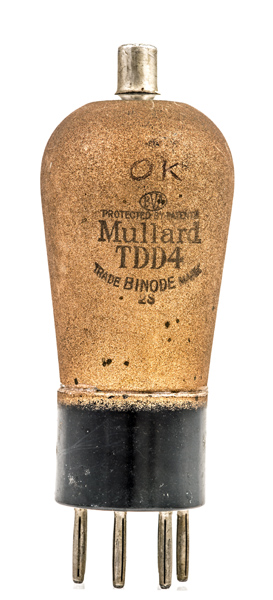
The TDD4 is an indirectly heated double diode triode for mains superhet receivers. It was designed for signal and AGC detection and then as the first post detection amplifier. The design was specifically aimed at sets employing AGC at the detector stage and was introduced by Mullard in 1933.
We have several versions all with different envelope shapes. This is the oldest version, but we believe the original production used a Bakelite moulding for the top cap. We believe that it almost certainly has a mica-based electrode assembly in which the top mica does not support the electrodes by contact with the glass envelope. The other three specimens have 'necked' glass envelopes into which the top mica is tightly fitted. This helped to reduce microphony, always a potential problem in a detector valve followed by significant amplification. The gradual lightening of the gold spray paint from batch to batch is also apparent.
SeeTDD4, TDD4 and TDD13C. The latter valve was designed for AC/DC universal sets.
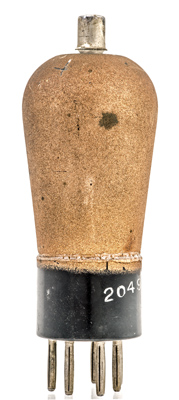
The reverse is plain gold coloured zinc loaded paint.
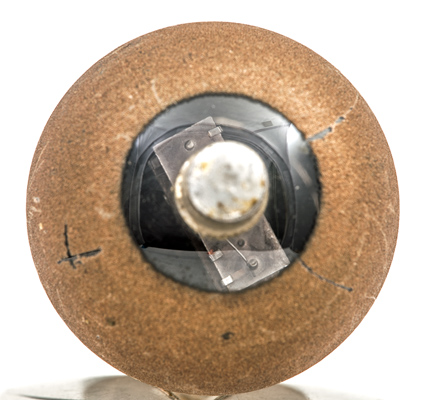
The top view reveals very little except the grid lead to the top cap.
The balloon envelope is 45 mm in diameter and, excluding the B7 base pins, is 105 mm tall.
References: Data-sheet & 1043. Type TDD4 was first introduced in 1933. See also1933 adverts.