|
Pen25Sensibly equivalent¶ to:BVA162 CV65 Pen24See also:
|
|
|
|
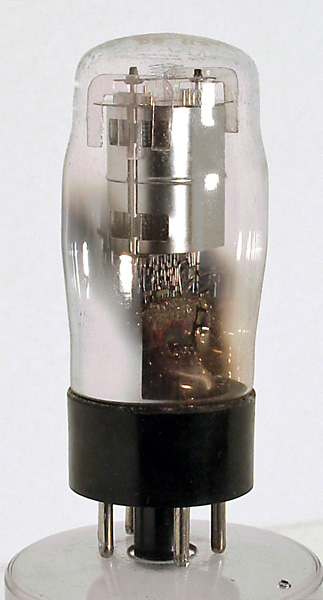
The 1938 Pen25 battery output pentode from Mazda was designed for domestic broadcast receivers. The filament was to be run from accumulators and the 0.15 Amp filament current would have assisted in prolonging the accumulator life.The British domestic radio industry was converted to war production during WWII and, much to BVA's distress, the floodgates were opened to the import of American technology and equipment.Immediately after the war Mazda tried to turn the clock back to the 1930s and re-build a distinctive British domestic market in which Americanism would find no toe-hold. See the 1946 advert above as an example. All other BVA members accepted the inevitable and set about making valves of essentially American design, supplying characteristically British types (if at all) for replacement purposes only. See Brimar GT Valves as an example.The on-going marketing of the Pen25 is one of Mazda's post-war anachronisms. Not only was it obsolete in concept, since it was oversized compared to the B7G types by then available for all-dry portables and there was little market for new 2 V battery 'household' radios, but it was also fitted with the new Mazda Octal base which made it incompatible with anything else, including the American International Octal which everyone else was using. This was the beginning of a slow decline in the fortunes of the one-time British market leader.R J Sutherland suggests another interpretation. In the late 30s, Mazda attempted to create a new series of valve based on their own octal base (including notably the SP41/SP61 that did such sterling service in various radar sets during the war), no doubt inspired by what the Americans were also doing. Whether this was an attempt to establish an industry-wide 'British Octal', as their data sheets sometimes called it, or a more commercially-inspired attempt to corner the market with a proprietary base is not clear. (Certainly no other manufacturer used them, as far as I know.) Be that as it may, it was in engineering terms a modestly progressive move from the old B5/B7 base. However, their efforts all came to nought, essentially because the octal base (of any kind) never caught on in the post-war domestic market in Western Europe to any great extent at all. The (yes, American-led) developments in the miniature valve during the war essentially allowed European set makers to 'leap-frog' the octal era, initially in favour of the 8-pin rimlock base. Perhaps US influences saw to the fairly early demise of that series, but that is another story! I don't see that Mazda attempted to persist with MO-based valves into the post-war era, not least because, if anything, there was a glut of surplus CV versions at the time. Like everyone, the firm moved to the rimlock base but with their own unique take on its construction (metal base with spigot) that they then carried over into their own quite extensive series of B9A valves (6F12 - 6F30 pentodes as just one small example). The MO - based valve was simply a victim of unfortunate circumstance.The filament is three inverted V's. The anode is a bright oval cylinder. The suppressor grid is an oval to match the anode, but the inner grids are nearly flat across the filament.The classic envelope is 30 mm in diameter and, excluding the MO base pins, is 70 mm tall.References: Data-sheet & 1040. Type Pen25 was first introduced in 1938. See also 1938 adverts. |
Pin Connections
| 1 | 2 | 3 | 4 | 5 | 6 | 7 | 8 |  f(-) | nc | a | g2 | g1 | nc | nc | f(+) |
|
|
Absolute Maximum Operating Conditions
| Vh | Ah | Va | Vs | Vg | mAa | mAs | ra | gm | Pout | D | 
| 2.0 | 0.15 | 120 | 120 | -3.6 | 5 | 1 | 0.35M | 3.0 | 0.4W | 16% |
|
Updated January 05, 2022.
|
|