|
DG7-32Sensibly equivalent¶ to:CV2431See also:
|
|
|
|
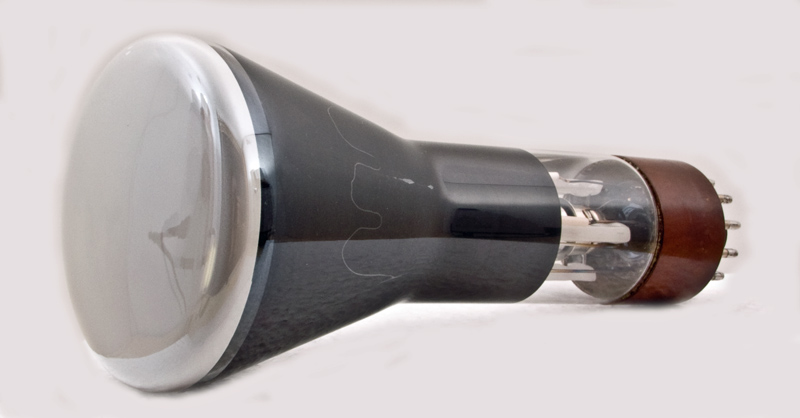
The well known DG7-32 (and its very close relative the DG7-31) is one of the most widely used and produced oscilloscope CRT's in the world. The small round oscilloscope tube has electrostatic focusing and deflection. The heater runs at 6.3 Volts and the EHT requirement is of the order of 800 Volts. The screen is 70 mm in diameter.This exhibit is a Mullard/Philips construction but unmarked. Sadly the markings were made with an ink that poor adhesion and was easy to wipe clean by accident.Initially produced by Mullard/Philips (sometimes seen with the Philips Miniwatt brand name) the tubes are now produced by various manufacturers including Matsushita, Svetlana et al. The tube first appeared as an improved version of the well known DG7/5, and was aimed at small portable oscilloscope use. However, it was rapidly adopted by numerous manufacturers and also became the basis for many home-brew oscilloscope kits. Still widely available today and commanding a high price, as well as oscilloscope use it finds uses in transmitter monitoring applications, television waveform monitors, industrial process monitors of various kinds and medical monitors. Additionally it is found in high-end professional radio tuners, amplifiers and signal generators. It has been proven to be a really versatile multi-purpose design. Less common variants included: short persistence blue phosphors for oscillographic applications and phosphors for television monitors.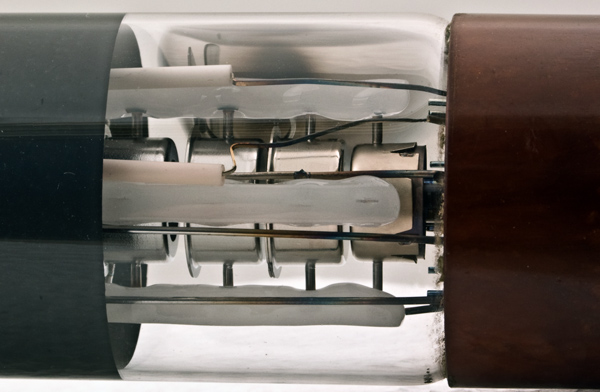
The gun on the right and the moving left are the focussing electrodes and accelerating anodes.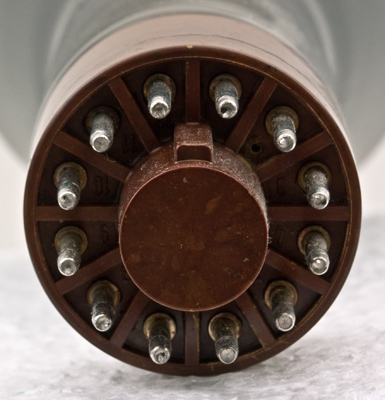
The 12 pin base.The end window envelope is 36 mm in diameter, and excluding the base pins is 155 mm tall.Reference: Data-sheet. Thanks to Anthony New for supplying the data-sheet. Type DG7-32 was first introduced in 1955. See also 1955 adverts. |
Pin Connections
| 1 | 2 | 3 | 4 | 5 | 6 | 7 | 8 | 9 | 10 | 11 | 12 |  h | g1 | k | g3 | nc | Y1 | Y2 | a,g2,g4 | X1 | X2 | nc | h |
|
|
Absolute Maximum Operating Conditions
CRT | Vh | Ah | 
| 6.3 | 0.3 |
|
PDF scanned from an original document held by the museum |
Updated July 31, 2024.
|
|