|
CV2128Sensibly equivalent¶ to:
|
|
|

|
The CV2128 is a direct equivalent of the commercial ECH81 the valve the specification was based upon.This triode heptode was designed for the role of frequency changer (mixer) in superhet receivers, the two valves share a common cathode. The triode is to be used as the local oscillator feeding the 13 Volts amplitude sine wave to the heptode mixer. Within the heptode, non linear operating causes the signals to interact to produce in the anode waveform the following major frequencies: signal, LO, signal + LO and signal minus LO. The anode circuit is tuned to enhance one of these signals, normally signal minus LO. For radio reception at the time an intermediate frequency of 455 KHz would be typical.The KB/DQ identifies this valve as being made to specification K1001 or K1006, the B denotes qualification by a UK authority and the DQ identifies the maker as Philips SpA, Milan, Italy.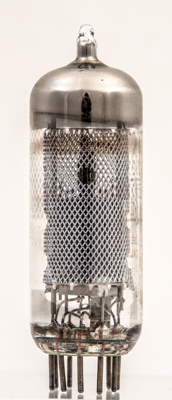
The triode is mounted above the mixer and both are surrounded by the outer screen. The anode lead has a screen behind it.
The anode sections are joined by the integral straps. Through the screen the wire grids of the mixer can be seen.The thin glass tube envelope is 20 mm in diameter and the valve is 59 mm tall excluding the B9A base pins.Reference: Data-sheet. Type CV2128 was first introduced in 1954. See also 1954 adverts. |
Pin Connections
| 1 | 2 | 3 | 4 | 5 | 6 | 7 | 8 | 9 |  g2,g4 | g1 | k,g5,s | h | h | a | g3 | a(t) | g1(t) |
|
|
Absolute Maximum Operating Conditions
| Vh | Ah | Va | mAa | 
| 6.3 | 0.3 | 100 | 13 |
|
Absolute Maximum Operating Conditions
| Va | Vs | Vg | mAa | mAs | ra | gm |
| 250 | 250 | -2 | 6.5 | 3.8 | 0.7M | 0.775 |
|
Updated November 18, 2025.
|
|