|
HK90Sensibly equivalent¶ to:See also:
|
|
|
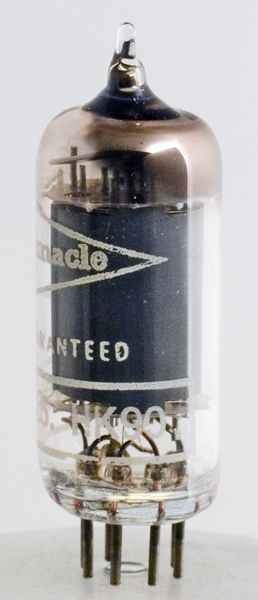
The HK90 heptode is classically used as a frequency changer in a superhet receiver. Radio and Television both use the superhet principle. To change frequency the incoming signal is mixed with a local oscillator. The electron stream is effectively switched on and off by the oscillator. In practice the process is one of producing sum and difference frequencies rather than just mixing of two signals.To prevent the oscillator and the signal interfering in unplanned ways a screening grid keeps the circuits apart.See also EK90 that is identical apart from the heater.The thin glass tube envelope is 18 mm in diameter, and excluding the B7G base pins is 46 mm tall.References: Data-sheet & 1040. Type HK90 was first introduced in 1950. See also 1950 adverts. |
Pin Connections
| 1 | 2 | 3 | 4 | 5 | 6 | 7 |  g1 | k | h | h | a | g2,g4 | g3 |
|
|
Absolute Maximum Operating Conditions
| Vh | Ah | Va | Vs | Vg | mAa | mAs | ra | gm | Vosc | 
| 12.6 | 0.15 | 250 | 100 | -1.5 | 3 | 7.1 | 1M | 0.475 | 10 |
|
Updated January 05, 2013.
|
|