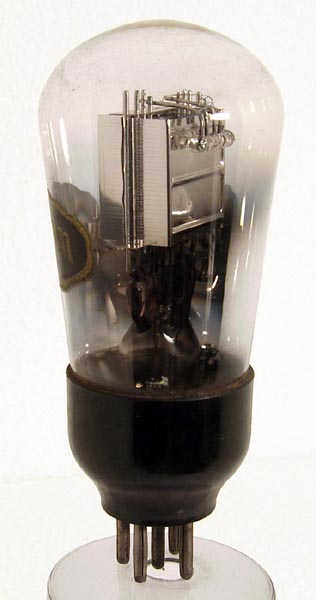
The M-OV type PT2 was a stalwart battery output pentode of the early 1930s until it was replaced by a tetrode equivalent type KT2, which was a critical-distance tetrode not a beam tetrode. We also have an example of the 'batkin' version PT2/K.
The PT2 was economical in battery current but was perhaps slightly under-powered for a household radio with a relatively inefficient moving-coil loudspeaker (i.e. cheap set with lightweight loudspeaker magnet); Moreover, as with most pentodes, the distortion rose quickly (and sounded ghastly) if you turned the volume up too much. The KT2 had a better characteristic, giving lower distortion and slightly more output power for the same demand in battery current. It gained a reputation for being considerably more powerful than the PT2 but we suspect its lower distortion plus marked improvements in loudspeaker magnets during the later 1930s had more effect than the actual increase in power output.
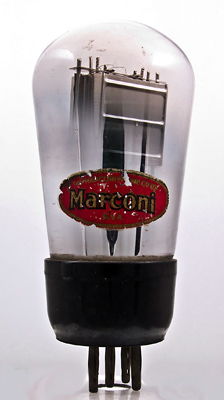
This exhibit has the earlier balloon envelope and glass rod on the side to hold the electrodes together with a small mica top strip - one step on from the Azide process. Our other PT2 has a round anode and mica top discs - clearly a later build when paste coating of the filament was fully established.
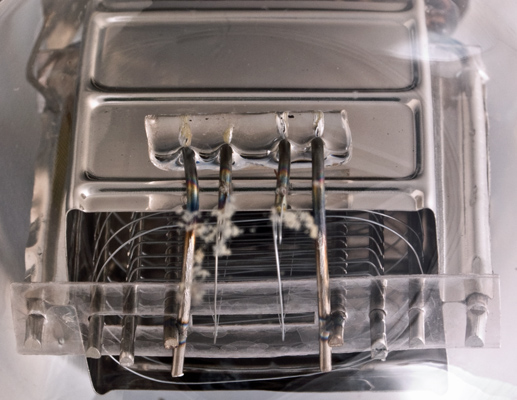
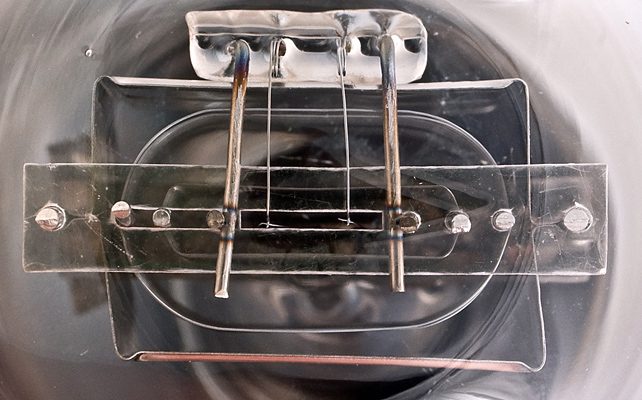
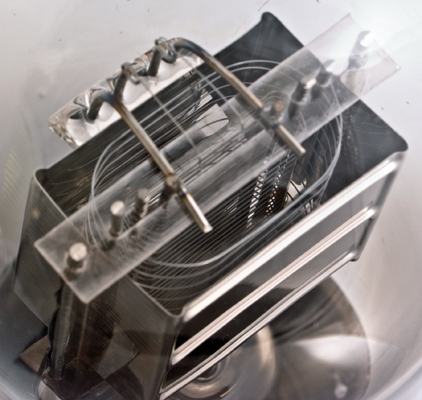
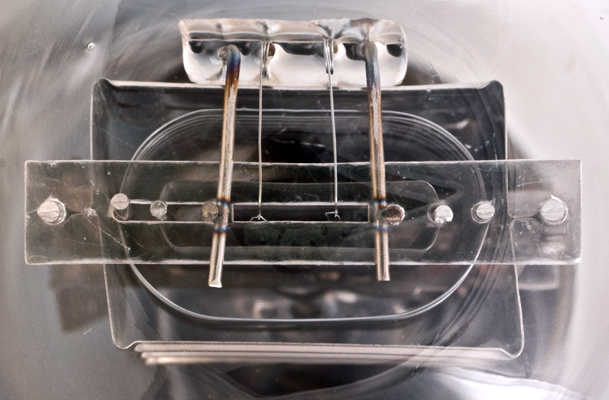
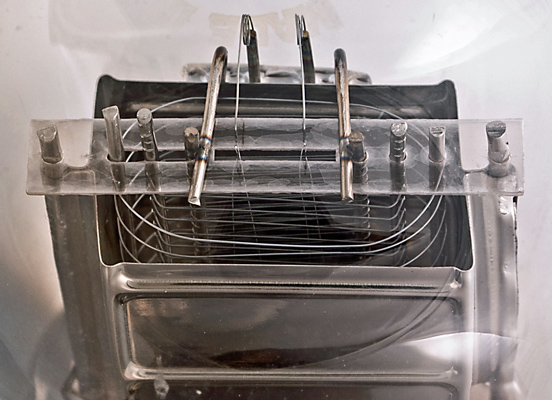
The following images are of another PT2 in the collection. Here the three grids and oxide coated filaments are seen. The tension springs for the filament are held in a glass rod that is itself held by wires to the control grid supports. These wires would provide a measure of extra cooling for the control grid.
Looking down on the dome of the envelope the shapes of the suppressor and screen grids can be clearly seen.
The grid wire spacing. Also the four filament strands can be seen passing down the valve.
The bright box anode.
The whole valve on the B5 base.
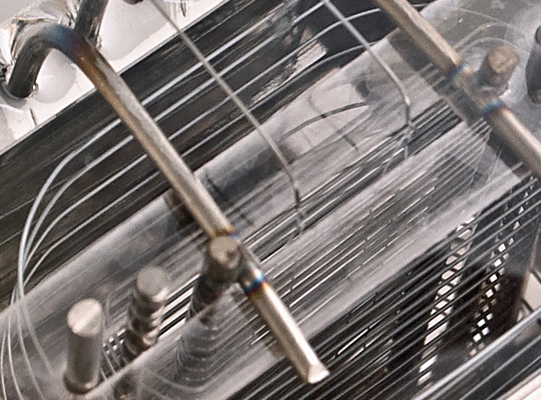
This image shows the hooks on the ends of the filament tension springs with the filament wire resting in the hook. The spring wire is coiled at the support end.
The different winding pitches of the grids is shown.
The balloon envelope is 48 mm in diameter and, excluding the B5 base pins, is 103 mm tall.
References: Data-sheet, Private communication & 1040. Type PT2 was first introduced in 1931. See also1931 adverts.