|
UCH42Sensibly equivalent¶ to:See also:
|
|
|
|
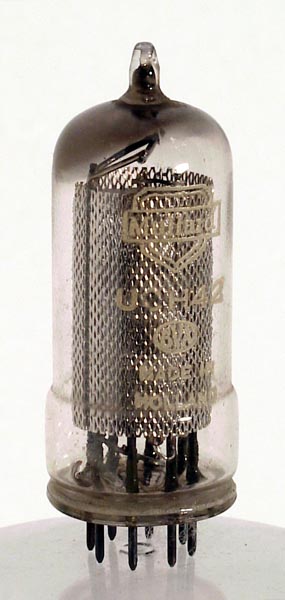
The UCH42 is an early all glass triode hexode from 1948 and was designed as oscillator and mixer for superhet receivers, and the hexode section was designed to operate with an AGC control voltage. The 100 mA heater was intended for universal (AC/DC) sets, and this explains the low anode voltages. Mullard do not give a frequency range for this device, it is, therefore unlikely to be greater than HF as the valve predates VHF broadcasting by more than a decade. Mullard also say that the UCH42 may be used as a phase inverter. The ECH42 is for AC sets and has a higher working anode voltage.The triode oscillator had to supply a peak to peak insertion voltage of 13 Volts.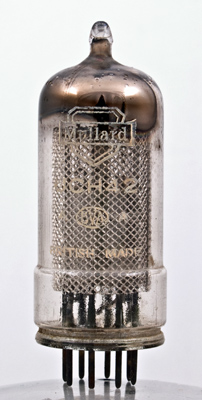
Another Mullard UCH42 but this time made in Britain. The construction of the envelope is the same. We believe that equipment designed at Philips would be used in both the UK and Holland, as one would expect within a group of companies.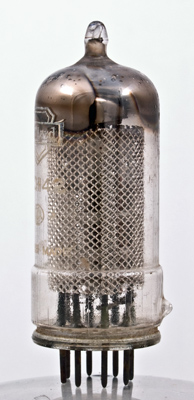
The locating pip is moulded into the glass skirt.The thin glass tube envelope is 20 mm in diameter and, excluding the B8A base pins, is 51 mm tall.References: Data-sheet & 1040. Type UCH42 was first introduced in 1948. See also 1948 adverts. |
Pin Connections
| 1 | 2 | 3 | 4 | 5 | 6 | 7 | 8 |  h | a | a(t) | g(t),g3 | g2,g4 | g1 | k | h |
|
|
Absolute Maximum Operating Conditions
| Vh | Ah | Va | Vs | Vg | mAa | mAs | ra | gm | 
| 14 | 0.1 | 200 | 85 | -2 | 3 | 3 | 1M | 0.75 |
|
Absolute Maximum Operating Conditions
| Va | mAa |
| 100 | 3.1 |
|
Updated December18, 2020.
|
|