|
The variable area film sound systems described by W H O Sweeny have oscillating beams with a natural frequency of up to 6 kHz that are moved by the audio signal. The oscillating mirrors 'chop' the modulating signal into segments i.e. they quantise the audio. The variable density system with a modulated light source is purely analogue.
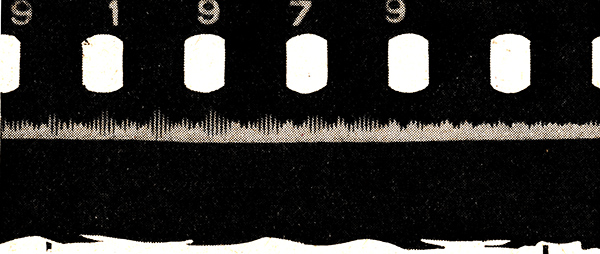
The variable area soundtrack.
The image of the soundtrack clearly shows the individual lines on the film, and the enlarged image below shows the detail.
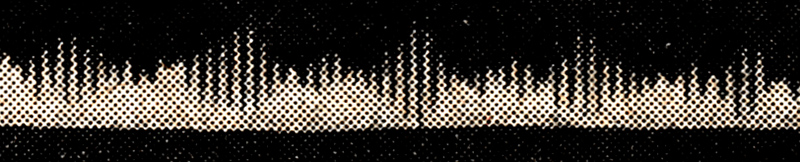
The individual lines of 'quantised' sound on the soundtrack
At a pulse repetition rate of 6 kHz, the Nyquist frequency [★] In signal processing, the Nyquist frequency, named after Harry Nyquist, is a characteristic of a sampler, which converts a continuous function or signal into a discrete sequence. In units of cycles per second, its value is one-half of the sampling rate. Wikipedia gives the upper limit for the modulating frequency as 3 kHZ.
In the same way that the eye interprets a series of still images projected at a rate above 16 frames per second as moving, the filtered audio recovered from the soundtrack will appear continuous. Today's mobile devices all use PWM audio amplification.
The author used a PWM modulated laser for free space communication in 2003 and with 3 mW of red diode laser power achieved a distance of 76.1 km. The carrier was set at 8 kHz and the audio filtered to the SSB bandwidth of 270 - 2,700 Hz.
|