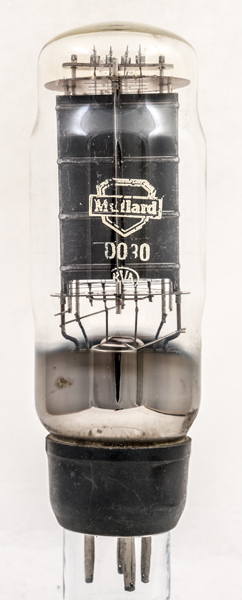
The DO30 was the Mullard equivalent of the M-OV DA30. Both are essentially uprated PX25's with a wider grid pitch. A single triode could produce 11.0 Watts into a 6,000 Ω load. The parameters here are from the 1951 Mullard Valve Data Book.
In a push-pull pair (Class AB1) the DO30's provide up to 45 W of undistorted audio for PA systems and transmitter voice modulation.
The advantage of Class AB1 is that it allows very high peak output with large variable signal levels (eg. audio) but consumes relatively little power whenever the signal level is (briefly) low, as with speech). The penalty is that a large negative grid bias is required and the peak signal input must be correspondingly high. Up to 288 V pk - pk. However, as the grid circuit does not need to consume significant amounts of audio drive power, the preamplifier can be a low power type and the high peak grid voltage requirements can be met by using a push-pull drive transformer. Heavy but efficient and cool-running.
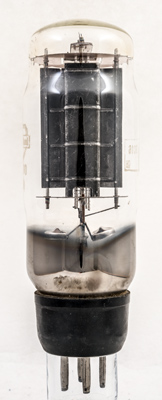
The anode is thin metal (Nickel) ribbed for rigidity. The flanges are present both for reaching the support struts and to provide extra radiating area at the point of maximum heat generation. The width of the anode cavity is greater than the PX25.
The code ZA8016 on the reverse.
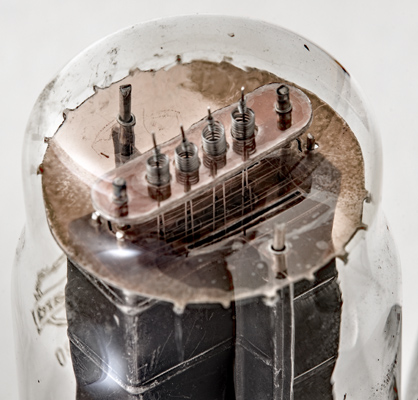
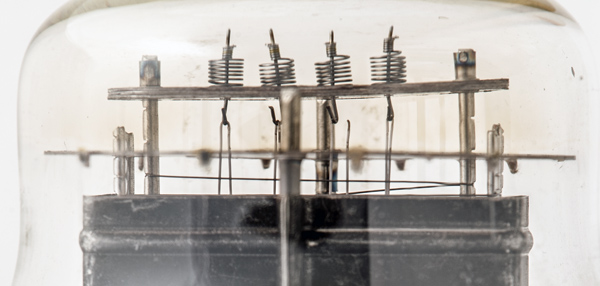
The top mica has four coil springs to tension the oxide coated filament wire.
The hooks hold the filament and here the third loop from the left is open. The notches in the control grid support indicate the winding pitch.
The classic envelope is 50 mm in diameter and, excluding the B4 base pins, is 140 mm tall.
References: Data-sheet & Data Book. Type DO30 was first introduced in 1937. See also1937 adverts.