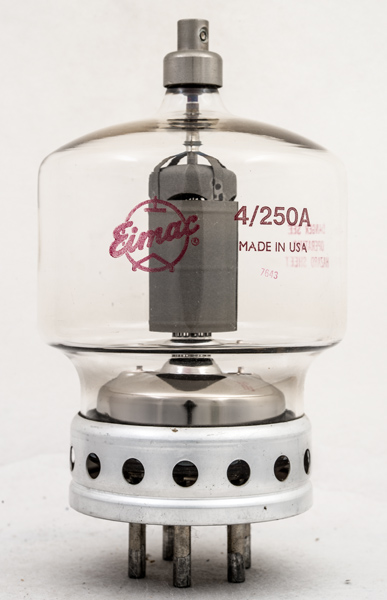
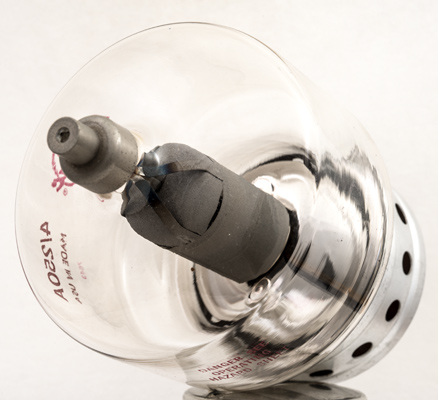
The 4/250A is an all glass power tetrode on a B5F base. The anode dissipation is given as 250 Watts. The maximum anode voltage was 4 kV.
The Eimac data-sheet gives the design use as an amplifier, oscillator or modulator.
Cooling is by anode radiation and force air cooling through the base and around the envelope. This suggests a chimney enclosing the envelope and directing the air flow.
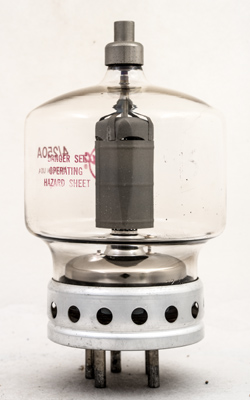
The reverse of the glass is a warning about operating hazards.
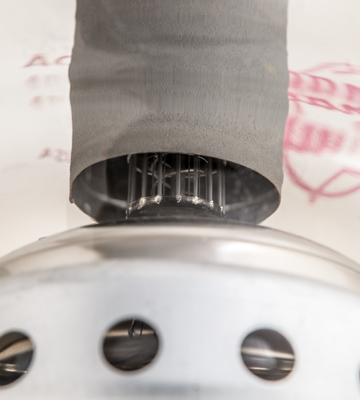
The filament is a double helix. The cage grids are aligned with the control grid being of a much thinner wire than the screen grid. The grids have wire around the circumference holding the wires in position.
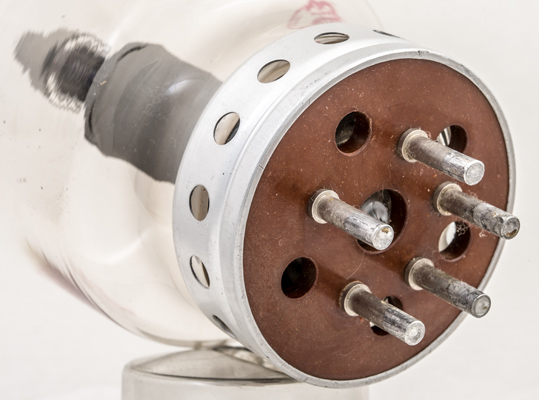
The B5F base with holes to allow the air blast to enter.
The anode is held only at the top. Through the gap in the side the grids can be glimpsed.
The wide glass tube envelope is 89 mm in diameter, and excluding the B5F base pins is 138 mm tall.
Reference: Data-sheet. Type 4/250A was first introduced in 1948. See also1948 adverts.