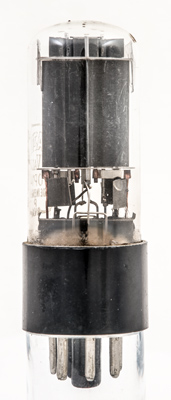
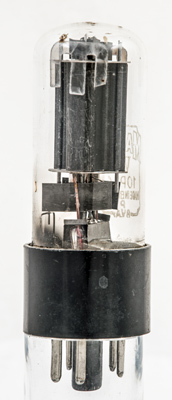
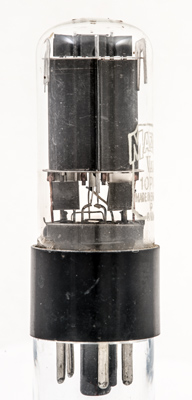
The 10P14 is an audio output valve, from 1947, designed for single end use in universal mains receivers. The 100 mA heater clearly identifies that it was aimed at equipment that used a few valves, like a radio receiver. we also have the 20P3 that is identical except for a 200 mA heater. The 10P13 is the same valve designed for a small envelope and B8A base.
The Mazda valve was designed after the time when Mazda gave up their own version of the octal base and adopted the International Octal.
The cathode resistor was designed to be 180 Ω and the anode load to be 3700 Ω.
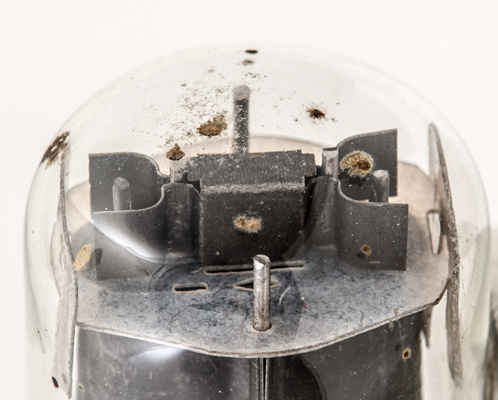
The control grid has heat radiating fins on both top and bottom of the two copper support rods. The lower fins are set to the outside of the envelope with tape connecting them to the grid support.
The anode has flanges on either side increasing the radiating area and providing places to anchor the support rods.
The grids pass flat across the rectangular cathode.
The top control grid heat sink.
The wide glass tube envelope is 29 mm in diameter and, excluding the IO base pins, is 78 mm tall.
References: Data & 1040. Type 10P14 was first introduced in 1947. See also1947 adverts.