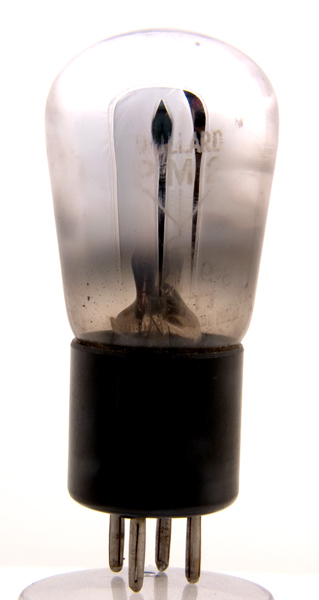
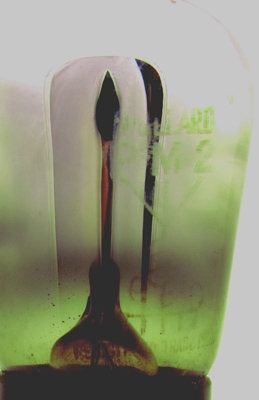
The Mullard PM2 is an audio output triode for use in battery driven receivers before the days of indirectly heated cathodes. The PM2 has an oxide coated filament made by the reduction of Barium Azide during production. The PM2 has a rated output of 150 mW.
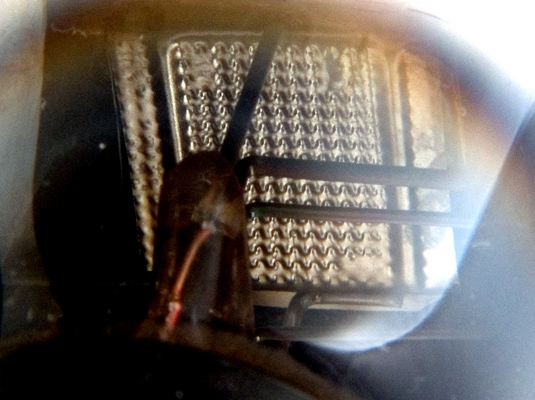
The silvering of the envelope from the firing of the getter obscures the electrodes. Seen obliquely up from the base the bright anode can be seen to lie horizontally above the pinch supported on stiff wires. The patterning on the anode is to enable the thin sheet to remain rigid, much as the structure of corrugated iron prevents the sheet from flexing.
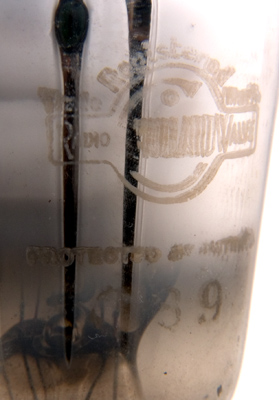
With some effort it was possible to photograph the Mullard identification. This is etched in the glass.
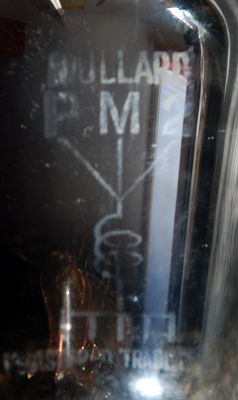
The Mullard logo depicting the symbols for aerial, coil and ground was exceedingly difficult to photograph as the image is formed just by etching the glass and on the coil the image is faint. This image was the result of a great deal of head scratching.
The best result obtained from the studio set-up.
The balloon envelope is 45 mm in diameter, and excluding the B4 base pins is 92 mm tall.
References: data-sheet & Data. Type PM2 was first introduced in 1926. See also1926 adverts.